


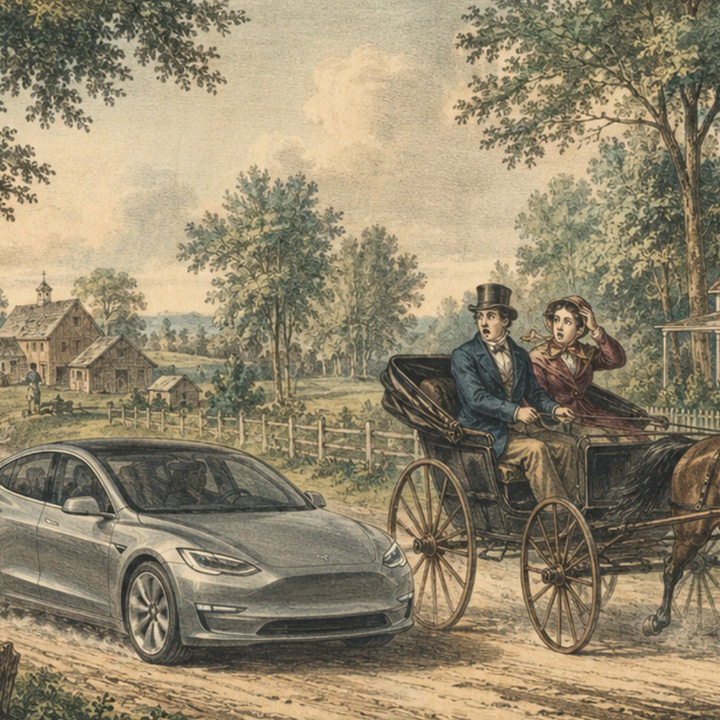
Imagine living in the 1800s, in a world built around the horse and buggy. Then, one afternoon, a modern electric car speeds silently down the road beside you.
It would be frightening, fascinating, and profound.
Our first instinct might be to define it in horse-and-buggy terms, perhaps as a “horseless carriage.” But that phrase would miss almost everything important. It would not explain its speed, its power, or how the sudden appearance of such a technology might affect society and commerce. No one standing there would likely fully grasp how that vehicle might transform the world.
That is where we are with artificial intelligence.
We are trying to describe a new category of power using old-world assumptions.
And the problem is not only that what we are witnessing is unfamiliar. It is that the technology is accelerating at a pace we have never experienced before.
As a Christian, I do not believe technology is evil simply because it is powerful. Human beings are makers because we are made in the image of God. But power always requires wisdom, humility, and moral restraint. The tools change. Human nature does not.
Here’s the challenge: Our political institutions were built to deliberate, debate, amend, and compromise. But AI is moving like fire in high wind.
The article below by Dario Amodei, the CEO of Anthropic, is a call to action.
The challenge is not to panic. It is to recognize the speed mismatch before the technology outruns the civic structures meant to govern it. And it is to remember that the question is not only what AI can do, but what kind of people we become as we build it, govern it, and integrate it into our lives.
Posted in JUNE 2026 / Chuck Green is a contributor to numerous magazines and websites, and the author of books published by Random House, Peachpit Press, and Rockport Publishers. All rights reserved. Copyright 2007-2026 Chuck Green. Contact.
Thoughts?