1 View
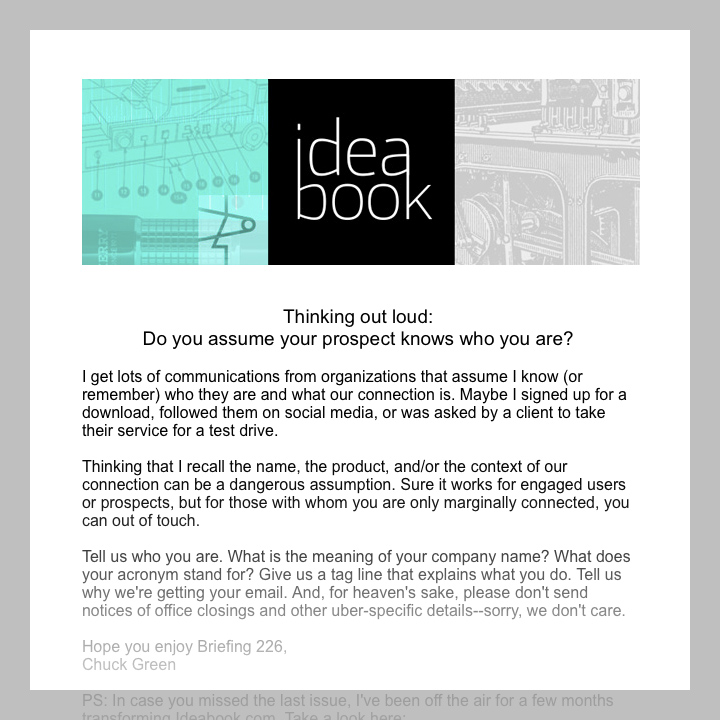
BY CHUCK GREEN Take a look at your design portfolio. Does piece one for client A have distinct similarities to piece one for client B? By that I mean, do the pieces share similar concepts and/or layouts? Do the same typefaces, color palettes, and types of imagery appear project after project? Is there a “look and feel” that permeates everything you do? If so, there could be a problem.
Continue reading "Commercial graphic design is not self-expression" »
1 View
BY CHUCK GREEN I believe that people on our periphery hold an extraordinary potential for positive influence that those closest to us do not. We (rightly so) should expect a certain level of encouragement from friends, colleagues, and family members, but when someone we don't know well, someone with no motive other than kindness, expresses even a small bit of interest in our lives, it can have a profound and powerful effect.
Continue reading "Victor Kryston, Dill Cole, The Eucalyptus Tree Studio, and the power of encouragement" »
Print Design
BY CHUCK GREEN Don't be fooled by the terminology—for most of us, “hard-sell” conjures up a less-than-pretty picture. You might even go so far as to say it smacks of intimidation, of someone trying to sell something we wouldn't buy unless we were talked into buying it. That is not the kind of hard-sell I'm going to talk about here.
Continue reading "Hard-sell design" »
Page Layout
BY CHUCK GREEN What do houses and well designed pages have in common? They are both built on a framework—a carefully measured, solid structure that forms a foundation on which to build. A grid is a combination of non-printing margins, columns, and guides used as the underlying framework of a page. Though any type of document can incorporate a grid, it is long, detailed documents such as magazines, newsletters, newspapers, and books that virtually require them.
Continue reading "Grids: an invisible foundation" »
Print Design
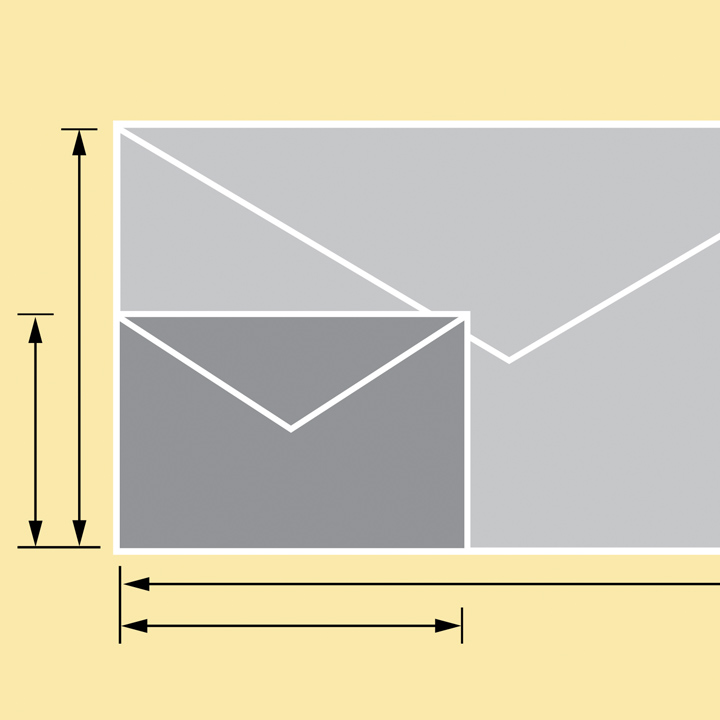
BY CHUCK GREEN Conventional thinking says a newsletter is a good way to keep your name in front of prospects and customers. And that producing one is both time consuming and costly. Conventional thinking also says a newsletter should be a minimum of four 8.5 by 11 inch pages and costs at least the standard letter rate to mail.
Continue reading "Postcard newsletters" »
Page Layout
BY CHUCK GREEN The truth is there is no secret design formula known only to professional designers. Readability is accomplished through a series of small, often subtle changes that anyone—designer or non-designer—can implement.
Continue reading "The readable page" »
Marketing
BY CHUCK GREEN “Branding” is one of those issues we picture the marketing VPs of Intel or Kraft Foods worrying about—hardly something for a small or medium sized business to concern itself with. It’s easy, after all, to appreciate the value of a brand like Coca-Cola, but near impossible to see how the same principles apply to an organization with an advertising budget something less than 30 million dollars.
Continue reading "Integrated branding" »
Print Design
BY CHUCK GREEN Write a book this afternoon. Sound preposterous? To the contrary—you can create an information-packed, 16-page booklet using a single sheet of paper in little more time than it takes to type the text.
Continue reading "The simple, small booklet" »
1 View
BY CHUCK GREEN Some time back I was asked, “What career advice can you offer to someone who wants to follow in your footsteps?” Beyond seeking the counsel of a clinical psychiatrist, here's my answer.
Continue reading "Advice for a new designer" »
1 View
BY CHUCK GREEN I don’t think of myself as an author. I am, more accurately, a designer who, periodically, squeezes a few words through the eye of the publishing needle. The fact is, if my high school English teacher, Mr. Kryston, had known I’d be writing for public consumption, I’m guessing he’d gladly have thrown himself on his sword for the better good.
Continue reading "About writing" »
1 View
BY CHUCK GREEN To me, design is a communication art and the people who practice it should be held, or hold themselves, to a far higher standard than the terms imply. Following are the standards I aspire to. Someday, I hope to get halfway to achieving them.
Continue reading "About design" »
Design Palettes
BY CHUCK GREEN The “word works” palette uses vivid colors and the beauty of elegant typefaces to do the job typically delegated to illustrations and photographs. And it is economical.
Continue reading "The word works palette" »
Logo Design
BY CHUCK GREEN Thought it would be fun to share one of the projects from my book Design-It-Yourself: Graphic Workshop, A Step-By-Step Guide. In addition to chapters on Establishing Your Mission, Do Some Research, Choosing Paper, and so on, the book includes 25 identity projects. The second half of the book focuses on newsletters. Here is one of the identity projects:
Continue reading "Logo ideas: A transparency project" »
Illustrations
BY CHUCK GREEN Instead of creating illustrations and photographs in a rectangle, think of the page as a surface on which to set your image. One of the things that makes this design distinctive is the recurring theme of setting a story-related object or objects on the table of the cover.
Continue reading "Using the page as a surface" »
Illustrations
BY CHUCK GREEN To get the maximum from stock and clip art, you need to develop a knack for seeing inside illustrations. For seeing beyond the limited application the illustrator had in mind, to the limitless potential of how the whole or its parts might be used to illustrate our specific applications.
Continue reading "Maximum illustrations" »
Illustrations
BY CHUCK GREEN Sometimes the easiest way to explain the product or service is to let the pictures do the talking. In this case they spell out the primary benefits in a way that is easy to digest.
Continue reading "Talking pictures" »
Typography
BY CHUCK GREEN What is so cool about design is that there is no such thing as not having enough to work with—budget, space, illustrations, and so on. If there is a limit, it is my imagination. And there's certainly nothing “wrong” with these headlines (figure 1)—but they sure grab more attention after I set them in an imaginary box (figure 2).
Continue reading "Illustrated headlines" »
Print Design
BY CHUCK GREEN Folds are as important to your brochure design as illustrations, typefaces, and color. A smart layout heightens the drama with which your message is revealed to the reader.
Continue reading "The form and function of folds" »
Typography
BY CHUCK GREEN To “kern” or adjust the space between letters and words (figure 1), try squinting at the text (figure 2) to identify spacing problems. Squinting makes it easier to spot, for example, the tight area between the “o” and the “a” in “goal” and to see how the “y” in “style” is surrounded by enough space to drive a tank through.
Continue reading "Squinting at headlines" »
Ideabook Info
Interested in offering free copies of the ideabook.com infocard to your group of 50 to 5000? On side one are inch, pica, millimeter, and point rulers, a basic color palette with CMYK values, charts of line values and shades of black and information about the site.
Continue reading "FREE Ideabook infocards for your class, meeting, user group, mailing, or event..." »
Page Layout
BY CHUCK GREEN Stuck for a new look? Try breaking some rules. Instead of surrounding every block of text with a gutter that is equidistant from all edges, try aligning the baseline of the text to the edge of the background (figure 1).
Continue reading "Lines and edges" »
1 View
BY CHUCK GREEN In thirty-something years of plugging away at this business, I have been called an art director, a commercial artist, a graphic designer, a desktop publisher, and a graphic artist (and, of course, a bunch of things we won’t go into here).
Continue reading "5 principles of good design" »
Technology
BY CHUCK GREEN This is a Fast Class. If I've done my job, in ten minutes you'll know: Why you should care about graphics file formats, the difference between vectors and bitmaps, and the common formats and software used to edit them.
Continue reading "Graphic file formats" »
Page Layout
BY CHUCK GREEN Often, the first solution that comes to mind when designing a newsletter (figure 1) or brochure is to align images in a random pattern (based on a grid). One interesting alternative is to group images together (in this case horizontally) (figure 2) and to allow that emphasis to carry the layout (figure 3).
Continue reading "Horizontal emphasis" »
Print Design
BY CHUCK GREEN A smart business card is a “tool“—a device that aids in accomplishing a task. It gives your contact a reason to keep your card within reach—it adds function to form. Yet, in an effort to save a few pennies in printing, millions of business cards are printed with a blank back—surrendering half the real estate on what is often our most widely circulated print piece. What should you include?
Continue reading "Tool cards" »
Ideabook Info
Ideabook.com is a resource for the designer, copywriter, illustrator, photographer, design student, and anyone else interested in the disciplines of design and marketing. Here are some of many kind words received about ideabook.com, jumpola.com, pageplane.com, and Chuck's books...
Continue reading "Kind words" »
Typography
BY CHUCK GREEN Is the primary purpose of document design aesthetic? To my way of thinking—no. The first and, by far, the most important role of design is to map out the message.
Continue reading "Type palettes" »
Print Design
BY CHUCK GREEN Need to make a big impression on a small budget? Send your prospect an object wrapped in a message. The trick is to find an item that helps you make your point.
Continue reading "Message wrap" »
Print Design
BY CHUCK GREEN Think outside the box. Does a newsletter have to be 8.5 inches wide and 11 inches high? Does it have to have a nameplate at the top of the cover with an article below it? Does it have to present 2.5 articles per page?
Continue reading "Tall news" »
Illustrations
BY CHUCK GREEN A woman stands up in a crowded city council meeting and reads the research. “We recently asked a random sampling of 250 citizens how often they use the new toll road. Five percent say they use it four or more times a week, eight percent say they use it one to three times a week, 12 percent say...” and continues on.
Continue reading "Every picture tells a story" »
Design Biz
BY CHUCK GREEN What is your understanding of the dynamics of the Client/Creative relationship? I've heard lots of opinions and countless complaints, but in all my wanderings, I have yet to find a good, non-legalese consensus of what we should expect of each other. A proposition that lays out the “spirit” of our relationship.
Continue reading "The design constitution" »
Web Design
Wait—don’t click away just yet—it’s not what you think—I'm not going to talk about color “theory”—the stuff that experts speculate about but can’t quite prove. Theory that states, for example, that one color represents anger and another represents happiness is interesting, but I've never figured out how to translate that information into action.
Continue reading "Color strategy" »
Typography
The typical computer font includes 256 characters. Upper and lowercase letters, numbers, computer codes, and a variety of characters for composing non-English text take up the majority of the available slots. But have you ever wondered what the rest of the characters are for?
Continue reading "The language of type" »
Design Palettes
BY CHUCK GREEN A design palette is a mix of basic ingredients— typefaces, photographs, illustrations, and color schemes—that, in one designer's opinion (mine), represents a distinctive mood or style.
Continue reading "The assertive palette" »
Logo Design
BY CHUCK GREEN One sure way to get a client excited about a new logo is to show them how it will be applied in the real world—show it in context.
Continue reading "Show logos in context" »
Marketing
BY CHUCK GREEN When was the last time you received a personal note from a colleague or a client? A handwritten message that expressed a feeling or a thought composed for you alone? If you're like me they are few and far between. I for one will not soon forget the CEO of a multi-billion dollar corporation who took the time to send a note of congratulations after a positive story about my business in the local press.
Continue reading "One-to-one marketing" »
Design Palettes
BY CHUCK GREEN This is one in a series of what I call "design palettes": the mix of basic ingredients—typefaces, photographs, illustrations, and color schemes—that, in one designer's opinion (mine), represent a distinctive mood or style.
Continue reading "The graceful palette" »
Print Design
BY CHUCK GREEN The book is a primary fiber of the information fabric. A form and function so deep-seated, new ways of delivering ideas, no matter how revolutionary, struggle against it. Even with the advent of the computer and Internet, I know few people who prefer it to reading from the printed page.
Continue reading "Create an out-of-the-ordinary booklet" »
Print Design
BY CHUCK GREEN Want to customize your brochure for a specific market or an individual customer? Ever wish you could magically add new products or services without reprinting? Searching for a big-dollar look on a shoestring budget? This design does it all and anyone can create it.
Continue reading "Mix and match brochure" »
Print Design
BY CHUCK GREEN The business card—many of us use it more than any other single marketing item, yet it very often demonstrates the least marketing smarts. A conventional card includes a logo and some basic information—the name of the organization, the name of the employee, their title, phone numbers, and street address. What can you do to make your business card generate business? That requires a little “jolt thinking.”
Continue reading "Rethink your business card" »
Print Design
BY CHUCK GREEN Call it the profound power of “free.” I don't know if you're like me, but I get excited about receiving unsolicited gifts in the mail—little unexpected promotional items such as pens, booklets, CD's, mouse pads, coffee cups, and such. If I encountered them in a store, they would not likely even catch my eye, but send them to my mailbox and you've got my attention.
Continue reading "Object marketing" »
Print Design
BY CHUCK GREEN “Distributing flyers door-to-door? Chuck, you gotta be kidding! Why,” you say, “would a forward-thinking, twenty-first-century kind of operation like mine, stoop to the stoop?” My sentiments exactly. When I first considered this idea, I thought the same thing. But once I did a little “jolt” thinking—the how, what, and why of doing things—I changed my mind.
Continue reading "Knock, knock door hangers" »
Print Design
BY CHUCK GREEN No matter what we offer online, in many if not most cases, we have yet to reach significant segments of our audience. As I see it, there are three obvious groups who are tough to reach:
Continue reading "Sell your site with a “Webcard”" »
Design Palettes
BY CHUCK GREEN Print design is two-dimensional—Web design is three-dimensional—a night and day difference. You page through a brochure in a straight line but you navigate a Web top-to-bottom, back-and-forth, and layer-by-layer. It is a vastly more complicated model. Our challenge as designers is not simply to communicate the message but to direct our readers through the message: to provide textual and visual signals that point the way.
Continue reading "Visual signals palette" »
Marketing
BY CHUCK GREEN When you travel a road over and over it develops a rut—a well-worn path of least resistance. Such is true with design. Once you've created a few brochures, newsletters or certificates, it's easy to forget their true purpose and why and how they work. It's easier to simply repeat the formula.
Continue reading "What is jolt thinking?" »
Print Design
BY CHUCK GREEN If you think post cards are for nothing more than “wish you were here” messages, think again. Post cards are serious marketing tools—tiny billboards with big missions. They are one of those often-used but little analyzed marketing mediums—a perfect platform for some “jolt thinking.”
Continue reading "Jolt thinking: the magic of mail" »
Print Design
BY CHUCK GREEN A savvy salesperson understands that you don't get far if you do nothing but sell. If you offer a service or recommend products, prospects want to know, before they buy, a little about you and if you are a credible source. One way to break the ice and demonstrate your knowledge of your particular field is to infuse your marketing materials with information.
Continue reading "Information marketing" »
Print Design
BY CHUCK GREEN “Formula” thinking defines a business card as your name, company, address, and phone number printed on a 2 by 3 1/2 inch white card. Formula thinking does what everyone else is doing. Effective marketing is all about presenting your unique advantage—it is anti-formula. A marketing-smart business card (figure 1) doubles as a brochure that presents your unique selling advantage and moves people to action.
Continue reading "Double duty business cards" »
Print Design
BY CHUCK GREEN The printing process can produce 1,000 examples of success as easily as it can produce 1,000 examples of failure. Whether you have your newsletter reproduced 100, 1,000, or 10,000 times, you—by the way you prepare the material for the press, oversee the printing, and review the results—control the outcome.
Continue reading "The designer’s prep, print,
and proof checklist" »
Logo Design
BY CHUCK GREEN I don't know about you but I love to see examples of how other designers work—they reveal better (or worse) ways of doing things and allow me to gauge whether my methods are mainstream or totally whacked-out. “If anyone finds out how I obsess about this stuff,” I tell myself, “they'll stick me in a home.”
Continue reading "Step-by-step logo" »
Print Design
BY CHUCK GREEN Finding just the right commercial printer for a particular job is an exercise in narrowing: you identify the ideal printing process, you locate companies with the equipment to execute that process, and you identify people who know how to get the most from that equipment.
Continue reading "How to find the right commercial printer" »
Illustrations
BY CHUCK GREEN Has it ever happened to you? Your project deadline is fast approaching and you find a gap that needs filling—you need the kind of clip art image that slows your reader down long enough to get them interested. The visual puzzle piece that explains your point in a way that words cannot. You search your arsenal of disks, catalogs, and CD's to no avail—minutes ago you were sailing along, now you're dead in the water.
Continue reading "How to choose and use clip art" »
Print Design
BY CHUCK GREEN Three proposals, three-hundred envelopes, three-thousand business cards, thirty-thousand brochures—if you don't spend a lot of time getting projects printed, how and where to do it can be daunting. If you do it every day, you know that the quality, pricing, and efficiency of various printing services varies dramatically from place to place and time to time.
Continue reading "How and where to print your projects" »
Typography
BY CHUCK GREEN My idea books include a section devoted to commissioning work from illustrators and photographers. I said there and repeat here that artwork commissioned for a specific project has an impact like nothing else can—it makes the publication uniquely yours.
Continue reading "Taming wild words" »
Ideabook Info
BY CHUCK GREEN Comedian A. Whitney Brown said, “The saving grace of humor is, if you fail, at least you don't have anyone laughing at you.” Take a break—here, for better or worse, are some favorite stories and jokes.
Continue reading "Funny stuff" »
Presentations
BY CHUCK GREEN People in computer ads make life and death presentations without breaking a sweat. I hate people in computer ads. For real people, at least most of the ones I know, making a big presentation is a daunting task. You must know your material inside and out, practice until at least four in the morning, and if you plan to use visuals, design images that supplement, not circumvent your presentation.
Continue reading "Tools and tips for quick, slick presentations" »
Marketing
BY CHUCK GREEN There has never been a better time to own a small business. Mass markets are splintering into micro markets. Rather than hiring and building when demand increases, many companies are opting to buy products and services from outside sources. The business paradigm of the twentieth century is shifting.
Continue reading "Smart marketing for small business" »
Marketing
BY CHUCK GREEN With your letterhead and business card, you first begin to build relationships with the people who will make your business a success. With a little creativity, you can turn these run of the mill materials into the kind of marketing tools that keep the mill running.
Continue reading "Create a smart identity" »
Marketing
BY CHUCK GREEN You wouldn’t dream of walking into the office of a potential customer and reading a litany of products, services, and prices. You introduce yourself, explore the customer’s needs, demonstrate how your product or service will meet those needs, and tell how you have produced results for others. Your brochure should do the same.
Continue reading "Create a smart brochure" »
Marketing
BY CHUCK GREEN Mail it, hand it out, hang it up, leave it wherever prospects congregate—a flyer, printed on one side of a letter-sized sheet, is among the least expensive, easiest to produce, and hardest working marketing tools.
Continue reading "Create a smart flyer" »
Marketing
BY CHUCK GREEN On one thing, the experts agree—follow-up is the single most important and least used marketing strategy. A promotional newsletter featuring trade news, customer success stories, and information about your products or services is an excellent way to establish and grow your relationship with customers.
Continue reading "Create a smart newsletter" »
Logo Design
BY CHUCK GREEN Don’t have the time or budget for a custom logo? Try creating a logo using clip art. Heresy? I think not. Don't get me wrong, if I was designing a identity program for a large organization, I obviously wouldn't use clip art.
Continue reading "Create a clip art logo" »
Illustrations
Not every project requires a “from scratch” solution. When I was asked to create an illustration to promote a program centering on a “reef” metaphor, I tracked down a clip art image from Dynamic Graphics (figure 1).
Continue reading "Clip art parts and pieces" »
Print Design
BY CHUCK GREEN The idea is to mix your marketing message with information your audience will keep at hand. In the case of the card used to promote ideabook.com, side one includes inch, pica, millimeter, and point rulers, a basic color palette with CMYK values, charts of line values and shades of black, and, of course, information about the site.
Continue reading "Promote yourself with a card" »
Illustrations
BY CHUCK GREEN Whether it's print or online communications, one simple way to punctuate the message or feeling you want to communicate is to inset generic images that build on the theme (figure 1).
Continue reading "Punctuate with images" »
Web Design
BY CHUCK GREEN How do you generate interest in a project without committing to a design—demonstrate the idea architecture. I created this flow chart recently as part of a proposal for a Web to an expert consultant. I used the page to communicate the big picture and linked to other sites to show the client examples of how we might handle each subject.
Continue reading "Idea architecture" »